Integrating Grumpy Kitty: A Practical Guide to Novelty Font Implementation
Understanding the Asset: Beyond the Novelty Factor
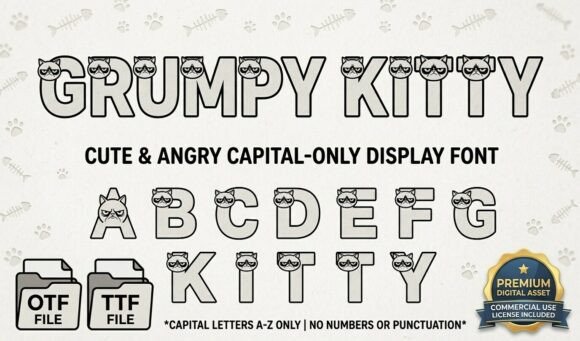
In the world of design and content creation, typography is often treated as a strictly functional element—chosen for readability or corporate professionalism. However, injecting personality into a project is a strategic decision that can significantly boost engagement, particularly in niche markets. Grumpy Kitty is a novelty display font designed specifically for this purpose. It is not merely a set of letters; it is a character-driven asset. The font features thick, chunky outline letters, but its defining characteristic is the small, perfectly unamused frowning cat face peeking from the corner of every uppercase letter.
Understanding the technical specifications of Grumpy Kitty is the first step in planning your workflow. Because this is an outline or "hollow" font, it behaves differently than standard solid typefaces like Arial or Helvetica. It creates a stencil-like effect where the interior of the letter is empty. This design choice dictates the font's best use cases: coloring pages, simple vinyl cuts, and apparel printing where the background color needs to show through the text. For the modern creator, entrepreneur, or hobbyist, recognizing this "hollow" nature is critical for quality control and ensuring the final output matches the intended vision.
Pre-Project Planning and Asset Preparation
Before integrating Grumpy Kitty into a project, a brief planning phase prevents common execution errors. Because the font relies on its outline to define the letter shape, the scale of the text is a primary consideration. If you use this font at a size that is too small, the thick outlines will merge, and the distinct cat face details will be lost or fail to cut properly on a plotter. Therefore, during the planning stage, you must determine the minimum viable size for your specific medium—whether it is a digital social media graphic or a physical vinyl sticker.
Compatibility is another factor to address early. Grumpy Kitty functions as a standard font file, meaning it installs directly into your operating system's font library. This makes it immediately accessible to standard design software such as Adobe Illustrator, Photoshop, Cricut Design Space, Silhouette Studio, and even standard word processors. However, because the font relies on negative space, you need to ensure your project's background is planned in advance. In a workflow where you are designing a t-shirt, for example, the color of the fabric becomes part of the typography. Planning the contrast between the font outline and the background color is essential for legibility and visual impact.
Apparel and Merchandise Production
For small business owners and print-on-demand entrepreneurs, Grumpy Kitty offers a specific advantage in the merchandise production pipeline. When creating designs for t-shirts, tote bags, or mugs, the "outline" nature of the font simplifies the manufacturing process. For heat transfer vinyl (HTV) users, this font requires only a single color of vinyl for the outline, reducing material costs and weeding time. The workflow involves typing your desired text, sizing it appropriately to account for the cat ears extending slightly beyond the standard letter bounding box, and then sending the job to the cutter. The resulting design allows the garment's color to become the fill of the letter, creating a professional, integrated look with minimal layers.
Digital Content and Branding
In the digital sphere, particularly for bloggers and social media marketers targeting the "cat lover" demographic, the font serves as a powerful branding tool. However, its usage requires discipline. Because Grumpy Kitty is highly stylized, it should generally be reserved for headlines, logos, or call-to-action buttons rather than body copy. In a typical content creation workflow, you might use a standard sans-serif font for the bulk of your article or post to maintain readability, then switch to Grumpy Kitty for the main title or a promotional graphic. This creates a visual hierarchy that draws the eye without overwhelming the reader. When using the font in software like Canva or Adobe Express, remember that the "hollow" center will show the layer behind it, which can be used creatively to overlay textures or images within the text.
Crafting and Physical Goods
For hobbyists and crafters, the application of Grumpy Kitty extends to paper goods and home decor. The font is ideal for creating custom coloring pages. By typing out a phrase and increasing the stroke weight slightly (if the software allows for outline expansion), you can create bold outlines that are easy for children or adults to color inside. Similarly, for stencil creation, the thick, continuous lines of the font ensure durability. The implementation process here involves exporting the text as a vector file (SVG) to ensure that the edges remain crisp regardless of how large you scale the design for a wall decal or a scrapbook layout.
Technical Execution and Quality Control
When moving from the design phase to the final output, quality control is vital. One common issue with outline fonts is the handling of negative space. If you are placing the Grumpy Kitty text over a complex background image, the hollow centers of the letters can become visually confusing. To mitigate this, a practical workflow step is to place a solid shape (a "knockout" or "backer") behind the text that matches the desired fill color or is simply white/black. This ensures the text remains legible while still maintaining the outline aesthetic.
Another technical observation involves letter spacing (kerning). Because the cat faces in Grumpy Kitty peek out from the corners of the letters, standard spacing might feel too tight, causing the cats to overlap with adjacent characters. During the implementation phase, it is advisable to manually adjust the tracking or kerning. This ensures that each cat face is distinct and the text does not look cluttered. Taking the time to tweak these spacing metrics is a hallmark of professional execution and ensures the "sarcastic humor" of the font is communicated clearly rather than lost in a jumble of shapes.
Long-Term Use and Strategic Application
From a long-term asset management perspective, Grumpy Kitty should be categorized as a "seasonal" or "niche" asset in your font library. It is highly effective for specific campaigns—such as International Cat Day, sarcastic greeting cards, or a specific product line for pet owners—but it may not suit every project. Efficient workflow involves tagging this font appropriately in your asset management system so you can retrieve it quickly when the tone of the project calls for a mix of cute and curmudgeonly.
Ultimately, the value of Grumpy Kitty lies in its ability to instantly communicate a specific personality. By treating it as a strategic tool rather than just a decorative element, you can streamline your design process. Whether you are a freelancer adding value to a client's pet boutique branding or a hobbyist making gifts for friends, the font provides a ready-made character that saves you the time of sourcing separate graphics. Proper preparation, attention to scale, and mindful layering are the keys to successfully deploying this unique typeface in any professional or personal context.